

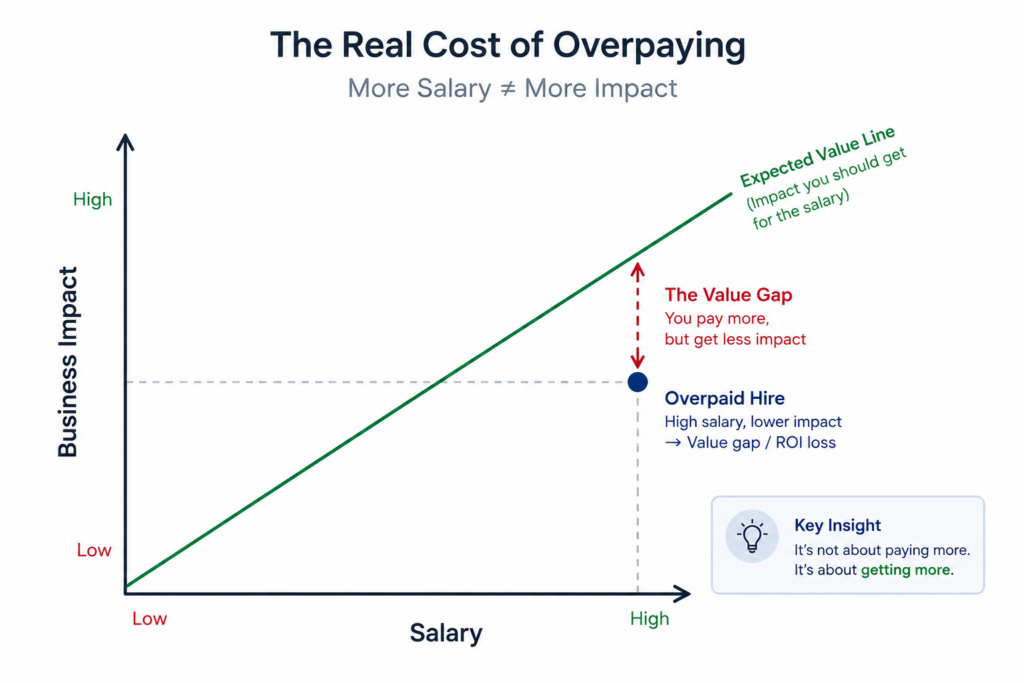
Quick answer: Salary and value aren’t the same number. A $200K developer can produce $80K of impact or $800K. The gap comes down to five things: productivity, specialization, time-to-impact, communication, and business context. Here’s how to actually measure it.
The story that keeps repeating
A hiring manager we work with once told us about a hire that looked perfect on paper. Big-name background. Senior title. Compensation that matched the market rate down to the dollar.
Eight months in, the team was slower than before he joined.
Nothing was technically wrong with his code. He just built things nobody asked for, in a way nobody else could maintain, and took four sprints to ship what a $140K engineer on the same team shipped in one.
Same salary band. Wildly different value.
This isn’t rare. It’s just rarely talked about, because “we overpaid for underperformance” isn’t a fun thing to admit in a performance review.
Why should you care?
If you’re hiring or managing IT talent right now, you’re probably anchored to salary benchmarks: what does a senior backend engineer cost in Dallas, what’s the market rate for a cloud architect, and so on.
Those numbers matter. But they answer the wrong question. The question that actually predicts ROI is “what do they produce, and how fast?”
Get this wrong and you’ll keep overpaying for the wrong profile, or worse, underpaying and losing the right one to a competitor who did the math correctly.
The 5 things that actually determine value
1. Productivity (output, not hours)
- Lines of code is a vanity metric; better ignore it.
- What matters: shipped features, resolved incidents, reduced technical debt, systems that don’t page anyone at 2am.
- A developer who ships less but breaks nothing is often worth more than one who ships fast and creates cleanup work for three other people.
Ask in the interview: “Walk me through the last project you shipped. What broke after launch, and who fixed it?”
2. Specialization (rare skill vs. commodity skill)
- A generalist full-stack developer is replaceable in weeks.
- Specialization drives price. But only if the specialty maps to a real, current business need.
- Watch for “resume specialization”: someone who lists a rare skill but hasn’t used it on a production system in years.
3. Time-to-impact (how fast do they become useful?)
- A $180K developer who’s productive in week 2 can out-earn their salary faster than a $150K developer who needs 4 months of ramp.
- Time-to-impact depends on: how well-documented your systems are, how much hand-holding they need, and whether they’ve worked in a similar stack before.
- This is where contract-to-hire and staff augmentation often win. You see real output before you commit to a full-time number.
4. Communication (the most underpriced skill in tech)
- The most expensive bugs are miscommunication bugs.
- A developer who communicates clearly and asks good questions early can prevent weeks of rework. That’s real, measurable value that never shows up on a resume.
- If you’re not testing communication in the interview process, you’re skipping the variable that predicts the most expensive failures.
5. Business context (do they understand why, not just what?)
- Developers who understand the business problem build the right thing the first time.
- Developers who only understand the ticket build exactly what the ticket said, even when the ticket was wrong.
- The difference compounds.
A simple way to reframe salary conversations, ask:
- What’s the cost of this role sitting empty for another month?
- What’s the cost of this person taking 4 months to ramp instead of 2?
- What’s the cost if they build the wrong thing because nobody explained the “why”?
Salary is a fixed number. Value is a moving target shaped by all five factors above. Hire and negotiate based on the second one.
The takeaway
The best hiring managers we work with have stopped asking “what’s the market rate?” as their first question. They ask “what does this specific role need to be worth it in 90 days?” then price around that.
Donato Technologies has spent 13+ years placing IT talent for companies who’ve learned this lesson the hard way. If you’re trying to figure out what a role should actually be worth before you post it, that’s a conversation we have daily — [reach out and let’s talk through it].