

BLS’s July 2026 jobs report shows -23,000 payrolls and a flat 4.1% unemployment rate. Here’s what it actually means for IT hiring — and what to do about it.
The July jobs report is out. Nonfarm payrolls fell by 23,000. Unemployment held at 4.1%. On the surface, that reads as bad news.
But if you’re hiring IT talent right now, the top-line number isn’t the story. The story is where the losses happened — and where they didn’t.
The quick version
- Total US jobs: -23,000 in July following an average monthly gain of 34,000 over the prior 12 months.
- Unemployment rate: 4.1%, essentially flat.
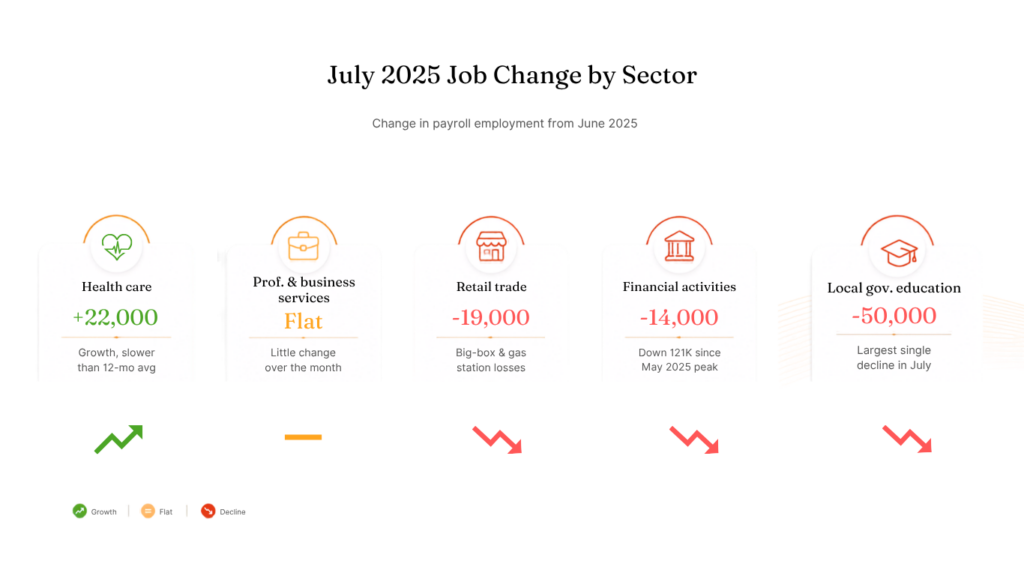
- Losses concentrated in local government education and retail. Retail trade lost 19,000 jobs, driven by cuts at warehouse clubs, supercenters, and other general merchandise retailers.
- Health care kept growing; up 22,000 in July, though that’s a slower pace than the average monthly gain over the prior 12 months (+36,000).
- May and June got revised down – combined, those two months are now 103,000 lower than previously reported.
- Wages ticked up slightly. Average hourly earnings rose 2 cents to $37.62, up 3.2% over the year.
Here’s the part that matters most for tech hiring: professional and business services showed little change over the month. That’s not a headline-grabbing number. But “little change” after months of downward revisions is actually a signal of stability, not stagnation — and stability is rare right now. U.S. Bureau of Labor Statistics
Why this matters if you’re hiring IT talent
1. The slowdown is real, but it’s uneven.
This isn’t 2020. It’s not a broad freeze. It’s sector-specific. Retail and local government education are shedding jobs. Financial activities are down 121,000 since a peak last year. Health care and professional/business services are the ones still adding or holding steady.
If your roadmap includes IT projects tied to health care, financial compliance, or B2B services, you’re hiring in one of the more resilient corners of the market.
2. Downward revisions mean the “strong labor market” narrative is softer than the headlines suggested.
May and June combined got revised down by 103,000 jobs. That’s not a rounding error. If you’ve been assuming candidates have tons of competing offers and you need to move fast and overpay, that assumption may be outdated. The market has more give in it than it did six months ago.
3. This is a good window to hire selectively, not aggressively.
A flat labor market with uneven sector performance usually means:
- Less bidding-war pressure on comp for mid-level roles
- More available candidates who were laid off from softer sectors (retail, finance) and are transferable into IT-adjacent roles
- Longer decision windows before a candidate takes a competing offer
That’s a window worth using, but only if your hiring process can move when you spot the right person. Slow internal approval cycles are the main way companies waste a market like this.
What we’re telling our clients right now
- Don’t wait for a “sign” the market has turned. It’s already showing you mixed signals: sector strength is the signal.
- Revisit roles you paused in Q2. If hiring freezes were about market uncertainty, this data doesn’t support waiting longer.
- Watch professional/business services and health care IT roles closely. These are the sectors with the least downside risk right now.
- If you’re staffing for compliance, cybersecurity, or data roles, this is a market where you can be more selective on skills match without losing candidates to a bidding war.
The bottom line
The jobs report headline says “little changed.” For IT hiring managers, that’s actually useful information: it means you’re not fighting the tide right now. You just need to know where to look.