

The Problem Is Not the Employee. It’s Often the Manager.
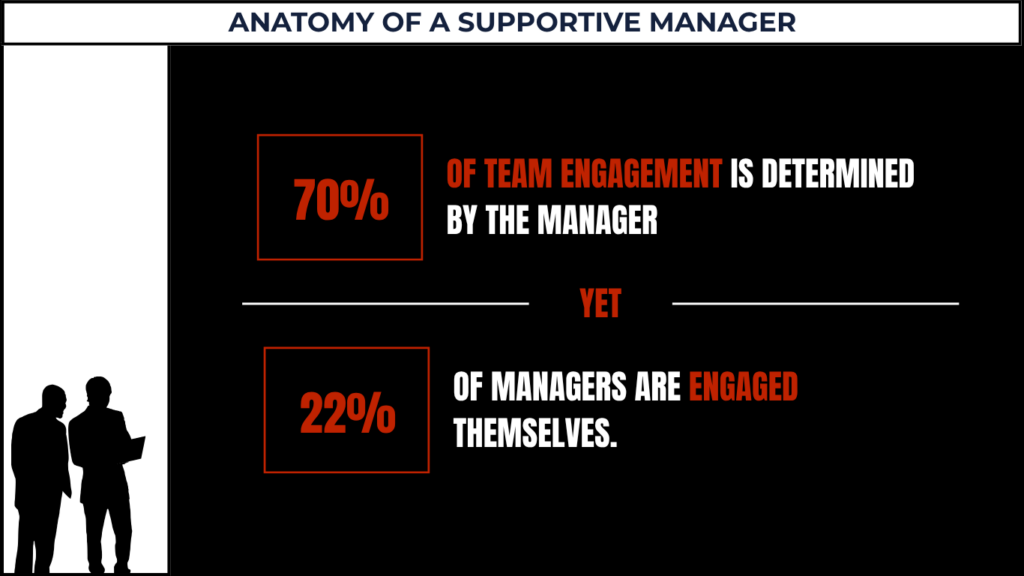
Gallup research consistently shows that 70% of the variance in team engagement can be attributed to the manager. Yet most organizations continue to promote high performers into management roles without equipping them with what the role actually demands. The Grossman Group
The result? U.S. employee engagement fell to its lowest level in a decade in 2024, with only 31% of employees engaged. An alarming 17% are actively disengaged. CAKE
This is not an employee problem. It is a management problem.
And it is expensive. Gallup estimates voluntary departures cost U.S. businesses roughly $1 trillion per year, with replacement running 0.5x to 2x a departing employee’s annual salary. Replacing a manager can cost up to 200% of their salary. WellhubHubstaff
The question for HR leaders and senior leadership is not “how do we hire better people?” It is “are our managers actually equipped to lead them?”
What a Supportive Manager Is Not
A supportive manager is not the person who shields their team from hard conversations. It is not someone who gives everyone a five-star review to avoid discomfort. And it is not someone who solves every problem for their team.
That approach creates dependency, not performance.
A study conducted with The Harris Poll found that 89% of managers believe their employees are thriving, while the actual figure is 24%. That is a more than 3-to-1 discrepancy.
Managers are often operating on assumptions rather than reality. Supportive management is not about perception. It is about what actually happens to the person in front of you.
1. They See the Person
Most performance systems are built around tasks, targets, and metrics. That is useful. But a manager who only sees outputs misses what is actually driving or blocking them.
A junior developer may not need more technical training. They may need confidence. A high performer may not need motivation. They may need permission to take real ownership. A struggling employee may not lack ability. They may lack clarity.
Only 46% of employees clearly know what is expected of them… a 10-point drop from 2020.
A supportive manager’s first job is to identify the invisible obstacle. Not to assume the solution.
2. They Balance Stability With Challenge
There is a common mistake in how organizations think about psychological safety. Safety does not mean removing accountability. It means creating the conditions where people can take risks, admit mistakes, and grow, without fear of punishment.
The best managers hold both at once:
- Clear expectations and consistent standards
- Room to experiment, fail, and develop
Employees are four times less likely to quit when psychological safety is high. But psychological safety without challenge creates comfort, not capability. A manager who removes every obstacle is not developing their team. They are building dependency. HiBob
The right balance communicates: You are capable. I expect you to rise to this. And I will support you while you do.
3. They Develop People Instead of Rescuing Them
Work Institute’s report attributed 63% of all 2024 employee exits to poor work-life balance and management issues. A significant portion of those exits trace back to one failure: managers who never helped people grow.
- A manager who sees someone struggling and thinks: I need to fix this for them.
- A manager who thinks: How do I help them develop the ability to solve this themselves?
The first creates a capable manager. The second creates a capable team.
According to LinkedIn’s Workplace Learning study, less than four in ten team members felt direct encouragement from their manager to pursue development in the past six months. That is a missed retention lever hiding in plain sight.
Practical look: Managers who develop people provide guidance without micromanagement, feedback without humiliation, and resources without removing ownership.
4. They Have Difficult Conversations… Consistently
Only 20% of employees strongly agree that their managers provide sufficient feedback.
Avoiding difficult conversations is not compassion. It is avoidance. And it has a cost both to the individual and to team performance.
There is a meaningful difference between feedback that attacks identity and feedback that addresses behavior:
- “You are not good enough” destroys confidence
- “This approach is limiting your effectiveness” builds capability
Supportive managers are direct. They name the issue, explain the impact, and point toward a better path. That is not harsh management. That is honest management and it is what high performers actually want.
As of 2025, about 71% of people say frequent recognition would make them less likely to leave their current role. Recognition and honest feedback are not opposites. They are both signals that a manager is paying attention.
5. They Connect Work to Meaning
Out of 59 factors studied, purpose had the strongest link to retention, making people 2.7 times more likely to stay. Organizations with a clear mission see 40% higher retention rates.
People do not stay engaged simply because they are compensated. They stay because they can see that their work matters.
The difference in manager communication is small but significant:
Instead of: “Complete this report.”
Try: “This analysis directly shapes how we advise our clients next quarter.”
Instead of: “Fix this issue.”
Try: “This is what our users depend on us to get right.”
That shift is not motivational theater. It is operational clarity. And it is the manager’s job to provide it.
6. They Examine Their Own Blind Spots
iHire’s 2025 Toxic Workplace Trends Report found that poor leadership was the most frequently cited cause of workplace toxicity. Nearly 75% of employees said they had worked for an employer with a toxic workplace at some point in their career. Pin
Most damaging managers are not intentionally difficult. They are unaware. A manager who cannot recognize their own insecurities will often:
- Micromanage because they fear losing control
- Reject feedback because they need to appear competent
- Take credit because they need validation
- Blame others because they cannot accept failure
The question every manager should regularly ask is: Is my reaction serving the team, or is it serving my ego?
That level of self-awareness is not taught in most management training programs. It should be.
7. Responsibility > Authority
Leadership is often framed as a reward. More authority, more information, more influence. But the defining quality of an effective manager is not what they receive. It is what they accept.
Their responsibilities include:
- Removing unnecessary obstacles
- Providing clarity on expectations
- Protecting the team from organizational chaos
- Giving honest feedback even when uncomfortable
- Recognizing contribution before it walks out the door
- Creating real paths to growth
Management quality is close behind compensation as a driver of preventable exits accounting for 29% of voluntary departures when you combine negative manager behavior and lack of positive manager interaction.
Those are not abstract HR metrics. That is a direct measurement of what happens when managers abdicate their responsibility.
The Five Qualities That Define a Supportive Manager
Across industries, the managers who retain teams and drive performance consistently demonstrate the same five qualities:
1. They set clear direction.
People know what they are working toward and why it matters.
2. They develop.
Their goal is to make the team more capable, not more dependent.
3. They hold standards without humiliation.
They have hard conversations because they respect the person enough to be honest.
4. They know their own weaknesses.
They do not let ego or insecurity drive team decisions.
5. They recognize the human being in the role.
They understand that performance is rarely just a skills problem.
What This Means for Your Organization
Between 2024 and 2025, manager engagement dropped by five points from 27% to 22%. Since 2022, Gallup finds manager engagement has dropped by nine points. HR Acuity
Managers are burning out at the same rate as the people they lead. That means organizations are not just dealing with a management quality problem. They are dealing with a management support problem.
Expecting managers to develop their teams when no one is developing the managers is an unsustainable model.
At Donato Technologies, we work closely with HR and business leaders to build the kind of workforce infrastructure that makes strong management possible, from identifying the right talent at the hiring stage, to supporting the organizational conditions that let good managers thrive.
The best managers do not create followers. They create stronger individuals. And strong individuals build the kind of teams that actually move a business forward.
What does manager effectiveness look like inside your organization? It may be worth finding out before the next exit interview does.