

There’s a persistent myth in software development: that process slows you down. That documentation, standardization, and quality checkpoints are the enemy of speed. Agile teams, in particular, have often treated “process” as a dirty word something bureaucratic, something from the waterfall era, something to be minimized in the name of moving fast.
But the best-performing engineering teams we work with don’t see it that way. They’ve discovered something counterintuitive: structured quality principles, borrowed from ISO 9001, they make Agile teams faster, more predictable, and far less likely to ship costly mistakes.
This isn’t about bolting a compliance framework onto your sprints. It’s about applying a handful of proven quality management principles to eliminate the rework, miscommunication, and technical debt that actually cause delivery delays.
The False Tradeoff: Speed vs. Structure
Agile was never meant to mean “no process.” The Agile Manifesto values individuals and interactions over rigid processes, but it doesn’t say quality controls are optional. Somewhere along the way, many teams conflated “move fast” with “skip the checks.”
The result? Sprints that ship features but also ship bugs. Retrospectives that identify the same root causes every two weeks because nothing structural ever changes. Technical debt that compounds silently until a release grinds to a halt.
ISO 9001, at its core, is a framework for one thing: doing things consistently well, and getting better at it over time. That’s a natural complement to them.
Four ISO 9001 Principles That Strengthen Agile Delivery
1. Continuous Improvement (Kaizen meets Retrospectives) ISO 9001’s Plan-Do-Check-Act (PDCA) cycle is, in essence, what a good Agile retrospective should be, except ISO 9001 insists that improvements are documented, tracked, and verified, not just discussed and forgotten. Teams that formalize their retro action items as tracked, owned, and reviewed improvements see measurably fewer repeat defects sprint over sprint.
2. Process Standardization Without Rigidity Standardizing how code is reviewed, how definitions of “done” are met, and how deployments are verified and removes ambiguity. When every engineer knows exactly what “quality” means for a given deliverable, less time is spent renegotiating expectations mid-sprint, and more time is spent building.
3. Root Cause Analysis Over Quick Fixes ISO 9001 requires organizations to identify the root cause of nonconformities, not just patch symptoms. Applied to Agile, this means bugs and production incidents get a real post-mortem. Teams that adopt this discipline see their defect rates drop over time, rather than plateauing.
4. Integrated QA, Not Bolt-On QA In ISO 9001 environments, quality is a shared responsibility built into every process step. Applied to Agile, this looks like QA engineers embedded in sprint planning, automated testing built into CI/CD pipelines, and “quality gates” that are part of the Definition of Done, not an afterthought at the end.
The ROI: What Structured Quality Actually Buys You
Organizations that blend ISO 9001 discipline with Agile delivery consistently report:
- Fewer production incidents, because root causes are addressed instead of recurring
- Faster onboarding, because standardized processes mean new engineers ramp up against a known playbook, not tribal knowledge
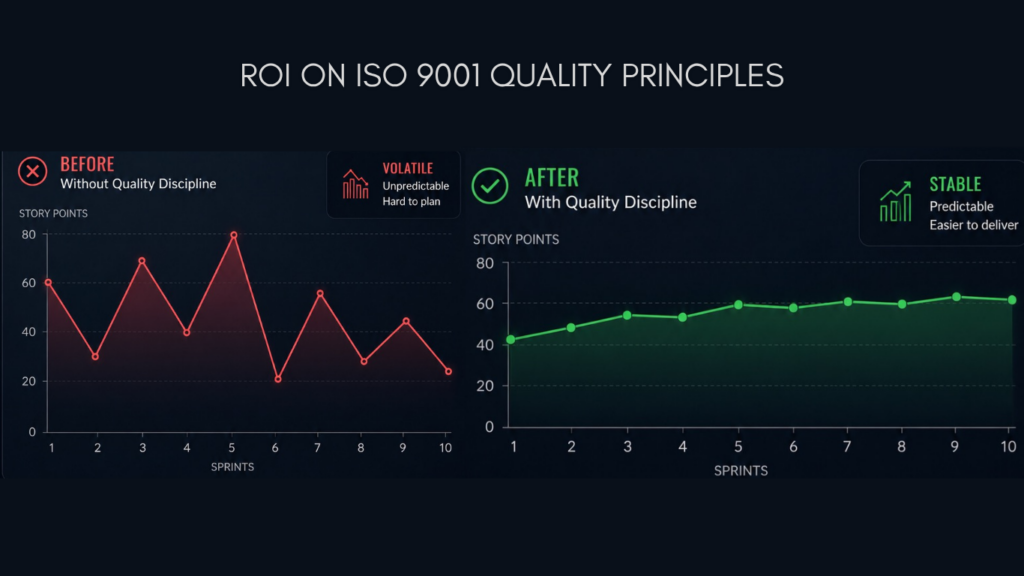
- More predictable velocity, because rework and firefighting stop eating into planned sprint capacity
- Higher client confidence, because deliverables come with a demonstrable quality trail
In short: the upfront discipline pays for itself many times over in reduced rework, fewer escaped defects, and delivery timelines teams can actually stand behind.
What This Means for the Talent You Bring In
Process frameworks are only as good as the people executing them. This is exactly why engineering discipline is a core filter in how we vet and place consultants. The candidates we put in front of clients are engineers who understand that quality is built in, not bolted on. They know how to work within structured Agile-plus-quality environments because that discipline is part of how we operate internally, and part of what we screen for externally.
When you bring in talent through a partner that treats quality management as a first-class engineering principle. You’re reinforcing the very process discipline that drives the ROI described above.
Quality isn’t the opposite of speed. Done right, it’s the thing that makes speed sustainable.