

Hiring in Texas Isn’t Easier. It’s Just Different.
Quick answer: Texas leads the U.S. in corporate headquarters relocations, but that doesn’t translate into easier tech hiring. Compensation, talent availability, and hiring dynamics vary sharply between Austin, Dallas-Fort Worth, Houston, and San Antonio, and companies that apply out-of-state playbooks typically lose their first hiring cycle. Winning here requires metro-specific compensation data, fast interview processes, and a local talent network built before roles open; which is why most expanding companies partner with a regional staffing firm rather than build that infrastructure from scratch.
Texas attracted more corporate headquarters than any other state in 2025. Dallas Fort Worth and Austin continue to draw companies with lower operating costs, no state income tax, and a growing tech ecosystem. Many executives assume hiring will be easier too. The answer may not be that straight-forward.
Texas isn’t a cheaper version of California or New York. It’s a different talent market with its own compensation expectations, hiring dynamics, and competitive landscape. Companies that succeed here adapt quickly. Those that don’t usually lose their first hiring cycle.
Why Do Companies Struggle to Hire Tech Talent in Texas?
Four assumptions cause most of the trouble. Each one feels reasonable coming from a coastal or international market. Each one fails in Texas.
Assuming a Strong Brand Travels
Your company may be well known back home. In Texas, you’re competing with employers candidates already recognize and trust. Brand reputation has to be built locally, not imported.
Thinking More Talent Means Easier Hiring
Texas produces exceptional engineering talent, but demand has grown just as fast as supply. The best candidates often have multiple offers before a job is even posted publicly.
Using the Wrong Compensation Data
Many companies either:
- Overpay using coastal salary benchmarks.
- Underpay because “Texas is cheaper.”
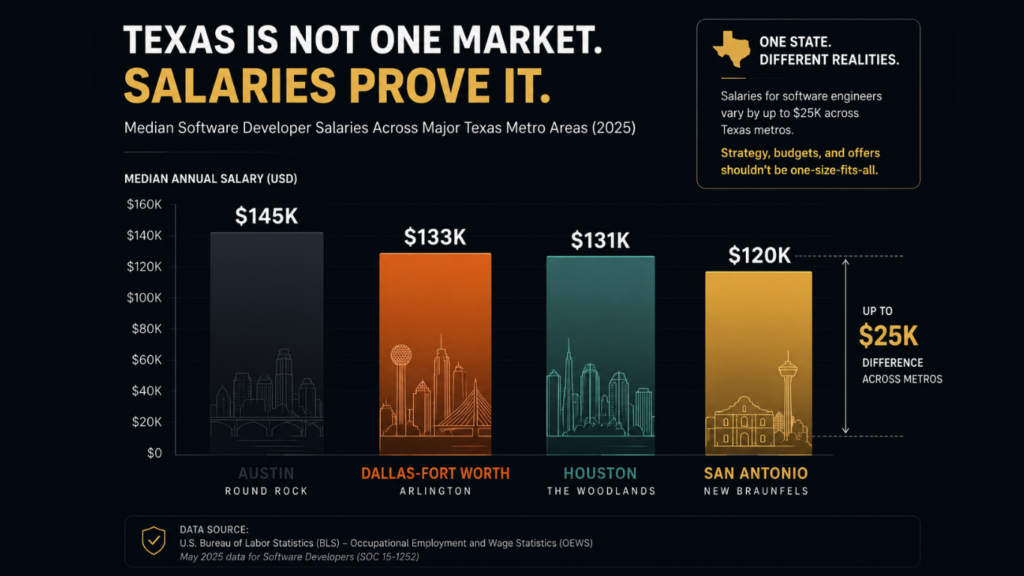
Neither works. Compensation varies significantly between Austin, Dallas-Fort Worth, Houston, and San Antonio. Benchmark by metro, not by state.
Treating Texas Like One Market
Austin, Dallas, Houston, and San Antonio each have different industries, talent pools, and salary expectations. A hiring strategy that works in Austin may fail completely in Dallas.
Is Austin’s Tech Market the Same as Dallas-Fort Worth’s?
No. Austin and Dallas-Fort Worth are the state’s two largest tech hubs, but they run on different industries and different comp curves.
| Metro | Core Industries | Hiring Dynamic |
|---|---|---|
| Austin | Software, semiconductors, AI, startups | Highest engineering comp in the state; heavy competition from anchor employers with large local campuses |
| Dallas-Fort Worth | Finance, enterprise tech, telecom, aerospace | Leads the U.S. in net new HQ relocations; broad enterprise demand |
| Houston | Energy tech, healthcare IT, logistics | Lower cost of living; growing but less saturated tech scene |
| San Antonio | Cybersecurity, fintech, government contracting | Smaller pool, less coastal competition |
Applying an Austin playbook in Dallas or vice versa is one of the fastest ways to stall a hiring plan.
How Should Companies Build a Hiring Strategy for Texas?
Move Fast
Top engineers don’t stay available for long. Slow interview processes lose great candidates.
Invest in Local Talent Pipelines
Universities like UT Austin, Texas A&M, UT Dallas, Rice, and the University of Houston continue to produce strong engineering talent. Building relationships early creates a long-term advantage.
Focus on Passive Candidates
The best people usually aren’t applying online. Referrals and local networks consistently outperform job boards.
Build a Local Employer Brand
Don’t wait until you have open positions.
- Participate in local tech communities.
- Sponsor meetups and industry events.
- Explain why you’re investing in Texas.
- Be transparent about compensation and career growth.
Candidates can quickly tell the difference between companies building a long-term presence and those simply opening another office.
Frequently Asked Questions
Is it harder to hire tech talent in Texas than in California? Not harder, but different. Texas has a deep engineering talent pool, but demand from relocating companies has caught up with supply, especially in Austin. Companies that treat Texas as a low-competition market are typically the ones who lose candidates to faster-moving local employers.
What is the average tech salary in Texas? It depends entirely on the metro. Statewide averages are misleading because Austin consistently commands higher engineering compensation than Dallas-Fort Worth, Houston, or San Antonio. Compensation bands should be set by metro and refreshed regularly, not pulled from a single statewide figure.
Why do out-of-state companies lose their first hiring cycle in Texas? Most commonly because they misprice compensation (either overpaying with coastal benchmarks or underpaying on the assumption that “Texas is cheaper”), move too slowly through interview processes, or treat Texas as one uniform market instead of several distinct regional ones.
Do Texas candidates prefer companies with an established local presence? Yes. Candidates can generally tell the difference between a company building a long-term presence in Texas and one simply opening a satellite office. Local visibility, transparent compensation, and community involvement built before roles open tend to outperform recruiting efforts that start only once positions are posted.
Local Knowledge Matters
Expanding into Texas isn’t difficult. Learning the market from scratch is.
The companies that hire fastest have two advantages:
- Current, metro-specific compensation data.
- Access to trusted local talent networks.
That’s where an experienced regional staffing partner makes the biggest difference.
At Donato Technologies, we’ve spent more than 13 years helping companies build high-performing technology teams across Texas through IT staffing, consulting, and direct placement services. Our local market knowledge and established talent network help clients avoid costly hiring mistakes and scale faster.