

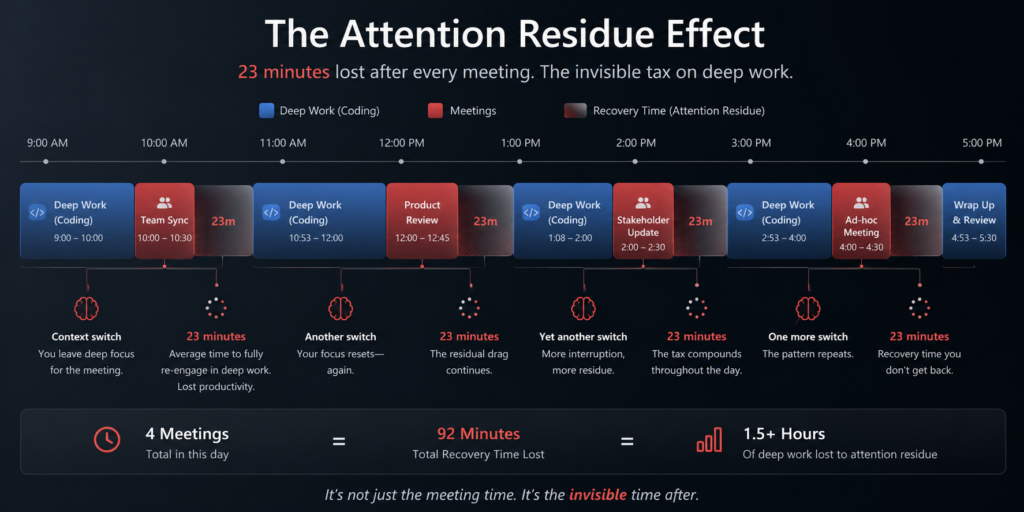
This isn’t another “meetings are bad” rant. Meetings aren’t the enemy, bad calendar hygiene is.
The math nobody wants to do
Here’s the thing about interruptions: the cost is more than the interruption itself.
Gloria Mark’s research at UC Irvine is the most-cited work here for a reason; it’s brutally consistent. Knowledge workers switch tasks every 3 minutes on average, with significant interruptions occurring every 11 minutes. And getting back to what you were doing? It takes an average of 23 minutes and 15 seconds to fully regain deep focus after a single interruption.
There is a documented cognitive pattern called attention residue, coined by Sophie Leroy at the University of Washington. When you switch from Task A to Task B, your attention doesn’t immediately follow. Part of your brain is still chewing on the thing you just left.
Instead of “multitasking” you’re doing two things badly at once, sequentially, forever.
For coding specifically, the damage compounds. Your working memory can hold about four chunks of active information such as call sites, variable states, the shape of the bug you’re chasing. Break the context, and that whole model is gone. That’s why engineers who face frequent interruptions show signs of mental fatigue much earlier in the day, leading to more errors in their afternoon work.
Shopify actually did the experiment
In January 2023, Shopify didn’t write a memo asking people to “be more mindful of meetings.” They ran a script and abruptly canceled all recurring meetings of three or more people company-wide, no warning.
The rules that replaced the chaos were simple:
No meetings on Wednesdays, full stop.
Meetings over 50 people limited to one weekly window on Thursdays.
A two-week cooling-off period before anyone could add a canceled meeting back and they had to justify it.
The results, six months later, according to internal data shared with WorkLife: 33% reduction in meeting time compared to the same period the previous year, and a 25% projected increase in completed projects. And the tell that matters most: most deleted meetings were never recreated.
Read that last part again.
That’s the actual insight. It’s that meetings should be opt-in, not opt-out. Right now your calendar defaults to “yes” for anything anyone schedules. Flip the default.
(For balance: not everyone’s sold. Dropbox tried meeting-free Wednesdays and dropped them, arguing that in remote-first teams, the meeting count is a bad proxy for org health – you’ll just cram everything into four days. The number of meetings is a poor metric for organizational efficiency is a fair critique. The fix is making people justify a meeting’s existence before it goes on the calendar.)
What to actually do about it
1. Kill recurring meetings by default, don’t reform them
Recurring meetings are the worst offenders because nobody re-evaluates them.
Once a quarter, delete every recurring internal meeting. Anyone who actually needs it puts it back and has to say why. You’ll find a third to half of them just… don’t come back.
2. Pick one no-meeting day and defend it like it’s on fire
Pick whatever day works for your team’s release cadence.
One caveat: this only works if leadership respects it too. If the EM books a “quick sync” on the no-meeting day because it was convenient for them, the whole system collapses in a week. Calendar hygiene is a leadership behavior, not an IC policy.
3. Replace status meetings with async updates
Most standups are status theater. Everyone reciting what they did yesterday to an audience that’s half-listening, waiting for their turn to talk.
If the meeting’s purpose is “share what I’m working on,” it doesn’t need to be synchronous. A written update in Slack or a shared doc, posted by 10am, does the same job without stealing anyone’s morning. Save the live conversation for genuine blockers (the stuff that actually needs two brains in the same room at the same time).
Use the “3 D’s” test before scheduling anything: does this meeting need to make a Decision, resolve a Debate, or handle something inherently interpersonal like a performance review, a “Discussion“?
If not, it’s an email.
4. Protect 2+ hour blocks, not 45 min scattered gaps
A calendar with three 45-minute gaps between meetings looks free. It isn’t. You can’t do real engineering work in 45 minutes when the last 23 are spent just getting your head back in the code. Block real, contiguous stretches (mornings work well since most people haven’t hit inbox fatigue yet) and treat that block as a meeting with yourself. Non-negotiable, same as any other calendar hold.
The honest caveat
None of this works if your culture treats “in a meeting” as the only legitimate reason to be unavailable, while “heads down coding” is treated as always-interruptible. That’s the actual root problem, and no calendar policy fixes it on its own.
No-meeting days, async updates, price-tagging invites are tactics. They buy you the space to build a culture where deep work is respected by default. They don’t create that culture by themselves.
Run the audit. Make people justify the meeting, not the other way around. Then actually check back in a quarter and see what crept back.