

Who this is for: CIOs, VPs of Engineering, and HR/Talent leaders deciding where to build or scale a technology function in 2026 — and evaluating whether Texas can actually support that bet, or whether it’s just cheaper real estate with a good PR team.
The question isn’t “why Texas” anymore. It’s “which part of Texas, and for which role.”
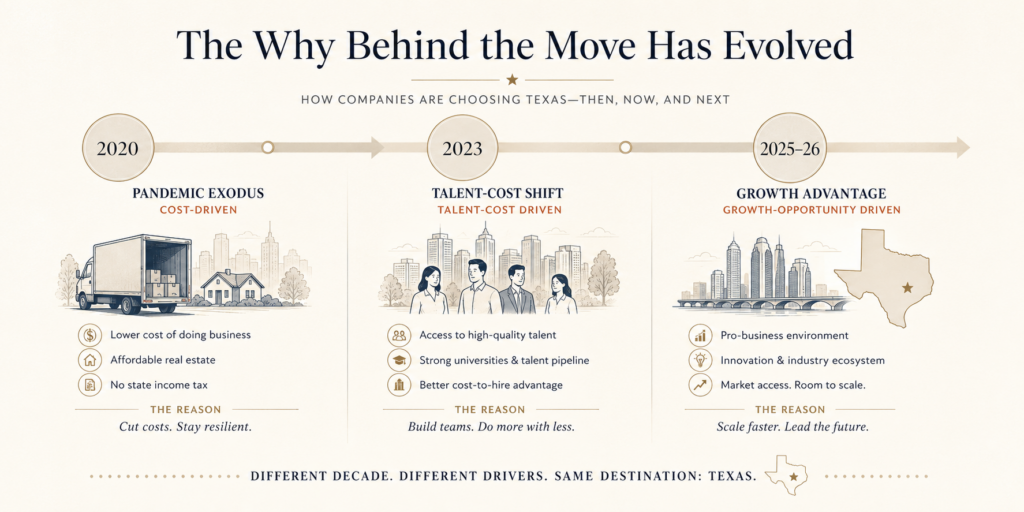
For a few years, “moving to Texas” was a single story: lower taxes, cheaper housing, escape the coasts. That story is now out of date. Texas in 2026 is three distinct ones (Austin, Dallas-Fort Worth, Houston), each with a different labor pool, cost structure, and industry gravity. Enterprise leaders who treat “Texas” as a single relocation decision are leaving talent and cost efficiency on the table. Leaders who understand the regional differences are building teams faster and cheaper than their coastal counterparts.
This matters because the decision in front of most enterprise leaders right now isn’t “should we have a Texas presence” most already do, or are actively building one. It’s “where exactly, and how do we staff it without repeating the mistakes of the last relocation wave.”
The data behind the migration is bigger than the headlines suggest
The relocation wave that started in 2020-2021 didn’t slow down it changed shape. CBRE’s 2025 analysis found headquarters relocation activity surged in 2025, with companies moving toward markets offering lower costs, tax advantages, stronger talent access, and office strategies shaped by hybrid work, as part of a broader redrawing of America’s corporate map favoring business-friendly metros in Texas, Florida, North Carolina, Arizona, Tennessee, and Georgia.
What’s changed is why companies are moving. In 2024, business climate and consumer access drove the decision. By 2025, growth opportunity had become the dominant factor CBRE recorded a nearly 47% rise in companies citing growth opportunity as the reason for relocating, up from 15 in 2024 to 22 in 2025, while labor availability accounted for 24 relocations and lower-cost tech talent specifically, the dominant driver from 2021 to 2023, fell to just three.
Why this matters to you: if you’re building a business case for a Texas expansion around “cheap labor,” you’re using a 2022 argument in a 2026 market. The companies winning here now are optimizing for access to talent density and growth infrastructure, not just lower payroll. That changes what kind of office, team, and hiring strategy actually works.
Regionally, Dallas-Fort Worth has pulled ahead on one specific metric that matters for enterprise HQ decisions: Dallas-Fort Worth-Arlington led the country in net new headquarters gained in 2025, adding 11, with Austin-Round Rock-San Marcos and Miami-Fort Lauderdale-West Palm Beach also ranking near the top.
The talent math actually works but the numbers are more specific than “it’s cheaper”
Here’s where most articles on this topic stop at generalities. The real numbers:
Tech job volume. DFW isn’t a secondary market anymore. The region ranks third in the U.S. for tech job postings, and CompTIA’s State of the Tech Workforce report projects DFW will add the second-most net tech jobs of any U.S. metro in 2026, trailing only New York. Texas as a whole ranks as the second-largest state for tech job postings behind only California.
Wage premium, not wage discount. The “cheap talent” narrative undersells what’s actually happening. The median tech wage in DFW sits at $119,634 which is 137% higher than the metro’s median across all occupations, placing it in the top quartile of U.S. metros for tech wage premium. That’s not a discount market. It’s a market where tech pay has decoupled from the regional cost baseline in the employer’s favor.
Purchasing power. This is the number that actually moves budget models. Indeed’s metro-adjusted analysis found DFW ranks seventh among U.S. tech hubs for cost-of-living-adjusted tech salaries, with an actual and adjusted salary that are effectively identical at $101,649 meaning a Dallas tech salary buys close to its full face value, unlike in coastal metros where the same nominal salary is eroded by housing and tax costs.
The tax structure compounds this. Texas has no state income tax, and the effect on take-home pay is direct and calculable: on a representative $78,400 base salary, estimated federal income tax runs about $9,100 and FICA about $6,000, with no state income tax collected, putting net pay at roughly $63,300 per year. Run that same salary through California’s state tax brackets and the employee loses several thousand additional dollars money an employer doesn’t have to make up in base pay to hit the same net compensation target.
Why this matters to you: if you’re modeling a Texas expansion using national average salary data, you’re likely overpaying to hit your target candidate pool, or underestimating what it takes to be competitive for senior engineering and architecture roles. DFW’s senior-level compensation is not “discount” , senior-level CTOs in Dallas earn between approximately $168,000 and $206,000 annually, and mid-level Cloud Engineers fall between roughly $96,200 and $119,900, with senior positions commanding up to $148,254 but the net cost per employee, after tax and housing adjustments, is where the real savings live.
AI hiring is where the real regional differentiation shows up
If your Texas strategy is specifically about AI or data engineering capacity, the data gets more interesting. DFW ranked fifth among U.S. metros for hiring in dedicated artificial intelligence roles, and demand extends well past those specialized titles DFW employers posted 38,828 jobs requiring an AI skill in the year ending January 2026, spread across virtually every industry rather than concentrated in one sector.
That last point is the one worth sitting with. In Austin or the Bay Area, AI hiring demand is concentrated in software and platform companies. In DFW, it’s distributed across finance, logistics, healthcare, and manufacturing employers who are all competing for the same AI-literate engineers. As CompTIA’s VP of industry research put it to the Dallas Morning News, the region is positioned to be at the forefront of both the broader AI shift and digital transformation trend.
Why this matters to you: if your competitive set for AI talent includes not just other tech companies but also regional banks, logistics firms, and manufacturers who are all hiring the same skill set, your recruiting timeline and offer strategy need to account for that a generic “we’re a tech company in Texas” pitch competes against employers who can offer domain-specific mission alongside comparable pay.
What this means for how you build the team, not just where you put the office
Three practical implications for anyone actually executing a Texas build-out in the next 12 months:
1. Speed-to-hire matters more than headline salary savings. With DFW adding the second-most net tech jobs of any metro in the country this year, competition for mid-to-senior engineering talent is intensifying in real time, not easing as headcount grows. A staffing or augmentation model that can move faster than a 60-90 day internal req cycle is the actual competitive advantage not the cost-per-hire spreadsheet.
2. Don’t assume the talent is fungible across Texas metros. Austin’s comfortable-living income threshold sits at $80,000–$95,000 due to housing costs, while Dallas, Houston, and Fort Worth fall in the lower $70,000–$80,000 range meaning your compensation bands, and the candidate pools they attract, are genuinely different by city, not just by cost-of-living index.
3. Build for the specialized layer, not just headcount. The compensation data shows the steepest premiums are concentrated in specific, scarce skill sets network security engineering, cloud architecture, and AI-adjacent roles where senior pay in Dallas already rivals national benchmarks. Generic “we need more engineers” hiring plans will hit a wall faster than plans built around where the actual talent scarcity sits.
Building or scaling a Texas engineering footprint is a workforce strategy decision, and the metros aren’t interchangeable. Donato Technologies works with organizations navigating exactly this kind of regional build-out, from IT staff augmentation to full technology team design, across the DFW market and beyond.
Sources:
CBRE 2026 Headquarters Relocation Report; CompTIA State of the Tech Workforce Report (March 2026); Indeed Tech Hub Salary Study; Motion Recruitment 2026 Dallas Tech Salary Guide; Dallas Innovates; Texas Economic Development Corporation.