Quick answer: A “5+ years” line measures time served, not skill. It shrinks your candidate pool, slows your hiring, and filters out people who could do the job in week one. Swap it for 3–5 outcomes for the first 90 days and a short work-sample test.
By the Donato Technologies team · Last updated November 4, 2026 · 6-minute read
Why should you care?
- Every week a tech req sits open, delivery slips and your current team covers the gap.
- The years-of-experience line is one of the cheapest things in your pipeline to fix.
- Most of your competitors are using the same filter, so you’re all fishing in the same pond.
What’s actually wrong with a 5-year requirement?
- Years aren’t skills. Five years of closing the same ticket queue isn’t five years of growth. Two years on a hard system can beat it.
- It’s usually a guess. Ask your hiring manager why it’s five and not four. Most of the time, it was copied from the last req.
- It screens out the wrong people. Career-switchers, veterans, and fast movers who’ve shipped real work all get cut.
- It makes you slower, not safer. A smaller pool means longer searches and more offers lost to faster companies.
What does the data say?
| What we looked at | The number | Source |
|---|---|---|
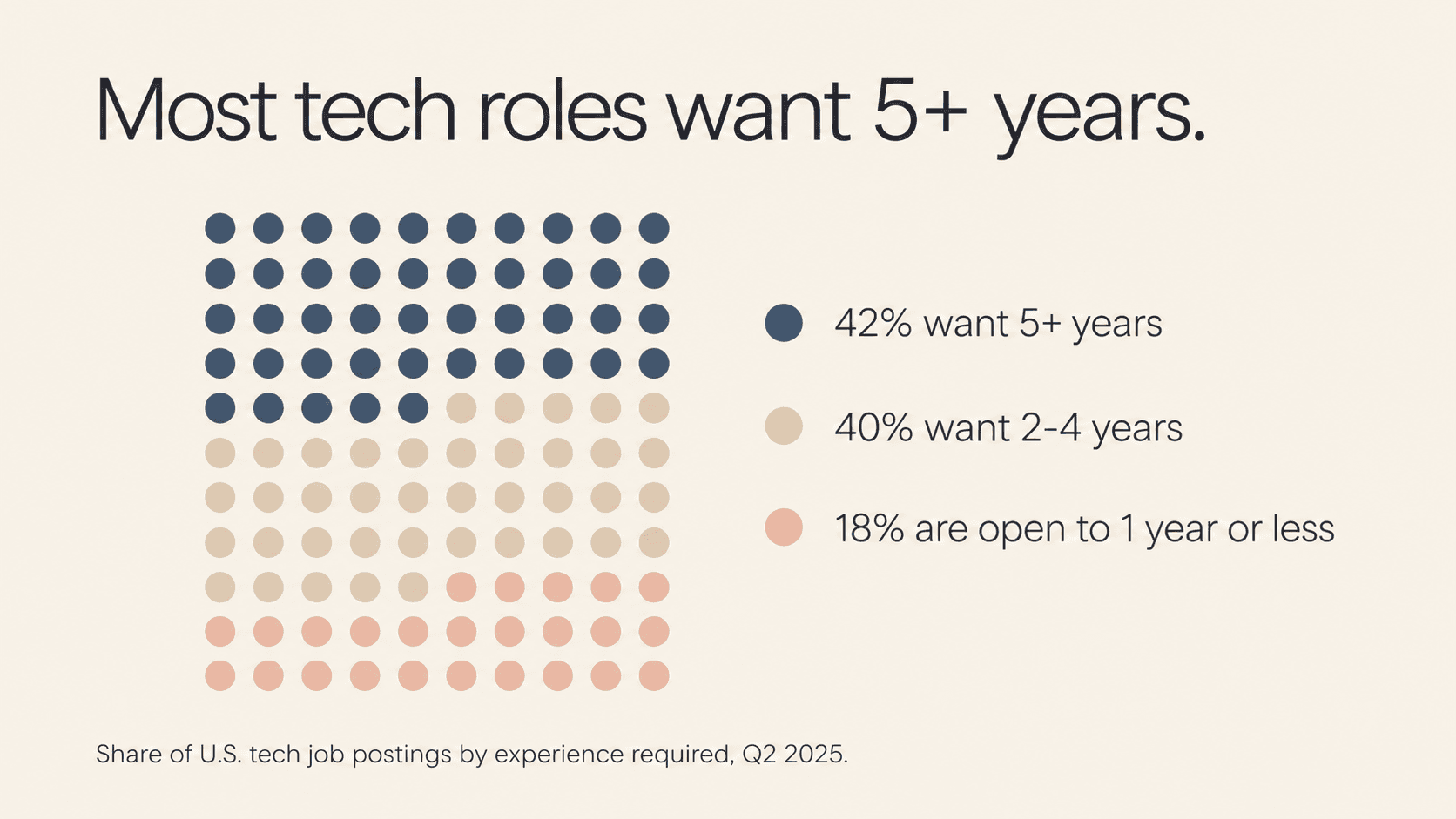
| U.S. tech postings asking for 5+ years of experience | 37% (Q2 2022) → 42% (Q2 2025) | Indeed Hiring Lab |
| Tech postings open to 1 year or less (among those listing a requirement) | 18% in Q2 2025 | Indeed Hiring Lab |
| Employers who say they use skills-based hiring | 70% | NACE Job Outlook 2026 |
| Hires actually affected by dropped degree requirements, 2023 | Fewer than 1 in 700 | Harvard Business School / Burning Glass Institute |
| Firms that changed the posting but not the hiring | About 45% | Harvard Business School / Burning Glass Institute |
Read that again.
Employers are asking for more years in tech, not fewer.
Almost everyone says they hire on skills. Almost nobody’s changed who they actually hire.
If you really change the process, you’re competing in a much less crowded lane.
Why doesn’t just deleting the requirement fix it?
Because the job post is only one filter.
The Harvard/Burning Glass study found nearly all the real change came from the 37% of firms that did more than edit a job description. Here’s what doesn’t work:
- Deleting the line but leaving the ATS knockout question (“Do you have 5+ years? Y/N”).
- Keeping the old rule in the recruiter’s screening notes.
- Hiring managers still sorting by pedigree because they have no other signal.
- Adding a skills test nobody calibrated. A test with no rubric is just a new gut feeling.
Removing the signal isn’t enough. You have to replace it.
What should you do instead?
- Write outcomes, not years. List 3–5 things this person should have done by day 90.
- Split must-haves from nice-to-haves. Keep must-haves to 4–5 skills. Long lists read like a unicorn hunt.
- Ask for evidence, not tenure. “What have you shipped, run, or fixed?” beats “How long were you there?”
- Use a 60–90 minute work sample from your real stack. Debug a failing pipeline. Review a pull request. Sketch a small API. If it runs longer than 90 minutes, pay for it or skip it.
- Run structured interviews. Same questions, same rubric, every candidate.
- Fix the plumbing. Remove ATS knockout filters, brief your recruiters, and track pass-through rates by stage.
Before and after (example)
Before:
Cloud Engineer
- 5+ years of cloud engineering experience
- Bachelor's degree in Computer Science or related field
- Experience with AWS, Azure, GCP, Kubernetes, Terraform,
  Ansible, Jenkins, Python, Go, Bash...
After:
Cloud Engineer
In your first 90 days, you'll:
- Move 3 legacy services onto Kubernetes with no downtime
- Cut our deploy time from 40 minutes to under 10
- Join the on-call rotation by month 3

Must-have: Kubernetes in production, Terraform, one major cloud
Nice-to-have: Go, Ansible
How we'll assess: a 90-minute pipeline work sample + a structured interview
Notice what’s missing: no years, no degree, no tool soup.
When do years still matter?
Sometimes. Here’s the honest take:
- Senior judgment roles. Principal architects, security leaders, and incident commanders learn a lot from watching real systems break.
- Regulated work. Some contracts and compliance frameworks require specific experience.
- Even then, write the why, not just the number. “Has run production incident response in a regulated environment” tells candidates more than “7+ years.”
And skills tests can go wrong, too:
- Four-hour take-homes lose good candidates.
- Puzzle questions that have nothing to do with the job don’t predict anything.
- Keep it short. Keep it real.
What about government agencies and prime contractors?
The public sector is already moving.
- Federal: OPM’s Merit Hiring Plan (May 2025) pushes agencies to use technical or alternative assessments in their hiring, limits self-assessments to minimum-qualification checks, and aims to get time-to-hire under 80 days.
- April 2026: OPM dropped the degree requirement from the federal IT management series (2210) in favor of formal skills assessments, and plans to revise its broader job series.
- States: Maryland started in 2022, and other states have since followed.
- If you’re a prime contractor: Read your labor category (LCAT) language. Many allow equivalent experience in place of a degree, or the reverse. Check what your contract actually says, and what your customer will accept, before you change anything. (This isn’t legal advice. Your contract language governs.)
How we pressure-test a req before we send a single résumé
Before we send candidates, we ask the hiring manager three questions:
- What does this person need to have done by day 90?
- Which requirement would you waive for the right person?
- How will you evaluate them, and when?
If the answers are fuzzy, we rewrite the req together first.
It’s the fastest way we know to shorten a search.
Got a tech req that’s been open 45+ days? Send it over. We’ll tell you which line we’d cut first.
FAQ
What is skills-based hiring?
It’s a hiring approach that evaluates candidates on demonstrated ability (work samples, structured interviews, real project evidence) instead of degrees, titles, or years served.
Is a 5-year experience requirement ever useful?
Yes, for a small set of roles where judgment comes from repeated exposure, like principal architecture or security leadership, or where a contract requires it. Even then, describe the experience you need, not just the number.
Does skills-based hiring actually speed up hiring?
Vendor surveys report big time-to-hire cuts, but most of those numbers are self-reported. The strongest independent research we found shows a clearer win on retention. Expect speed gains mainly from a wider pool and fewer wasted interviews, and measure your own results.
How long should a technical assessment take?
Aim for 60–90 minutes, tied to a real task from your stack, scored with a rubric. Anything longer should be paid.
Do we have to drop degree requirements too?
Only if no law, contract, or license requires one. If you can’t name the work that needs the degree, drop it.
Sources
- Indeed Hiring Lab, Experience Requirements Have Tightened Amid the Tech Hiring Freeze (July 2025): https://www.hiringlab.org/2025/07/30/experience-requirements-have-tightened-amid-the-tech-hiring-freeze/
- Harvard Business School & Burning Glass Institute, Skills-Based Hiring: The Long Road from Pronouncements to Practice (Feb 2024): https://pw.hks.harvard.edu/post/skills-based-hiring-the-long-road-from-pronouncements-to-practice
- HR Dive coverage of the Harvard/Burning Glass report: https://www.hrdive.com/news/employers-failing-at-skills-based-hiring/707897/
- NACE Job Outlook 2026: https://resources.trueability.com/statistics/skills-based-hiring-statistics-trends-2025
- OPM Merit Hiring Plan fact sheet (May 2025): https://content.govdelivery.com/attachments/USOPM/2025/05/29/file_attachments/3275471/Merit%20Hiring%20Fact%20Sheet%20FINAL%20PDF%20VERSION%205-29.pdf
- FedWeek summary of Merit Hiring Plan requirements: https://www.fedweek.com/issue-briefs/report-summarizes-hiring-policy-changes-issues-for-congress/
- Nextgov, OPM Cuts Degree Requirements for Government Tech Jobs in New Standards (April 2026): https://www.nextgov.com/people/2026/04/opm-cuts-degree-requirements-government-tech-jobs-new-standards/412884/