Logos don’t tell the whole story. Startups understand how valuable their early customers are to their long-term success. They understand that within their customer success stories lies the power of influence.
What they often don’t understand is how to make their customer success stories generate consistent deal flow. They are holding those stories tightly in their hands and folding too soon when they should be going all in.
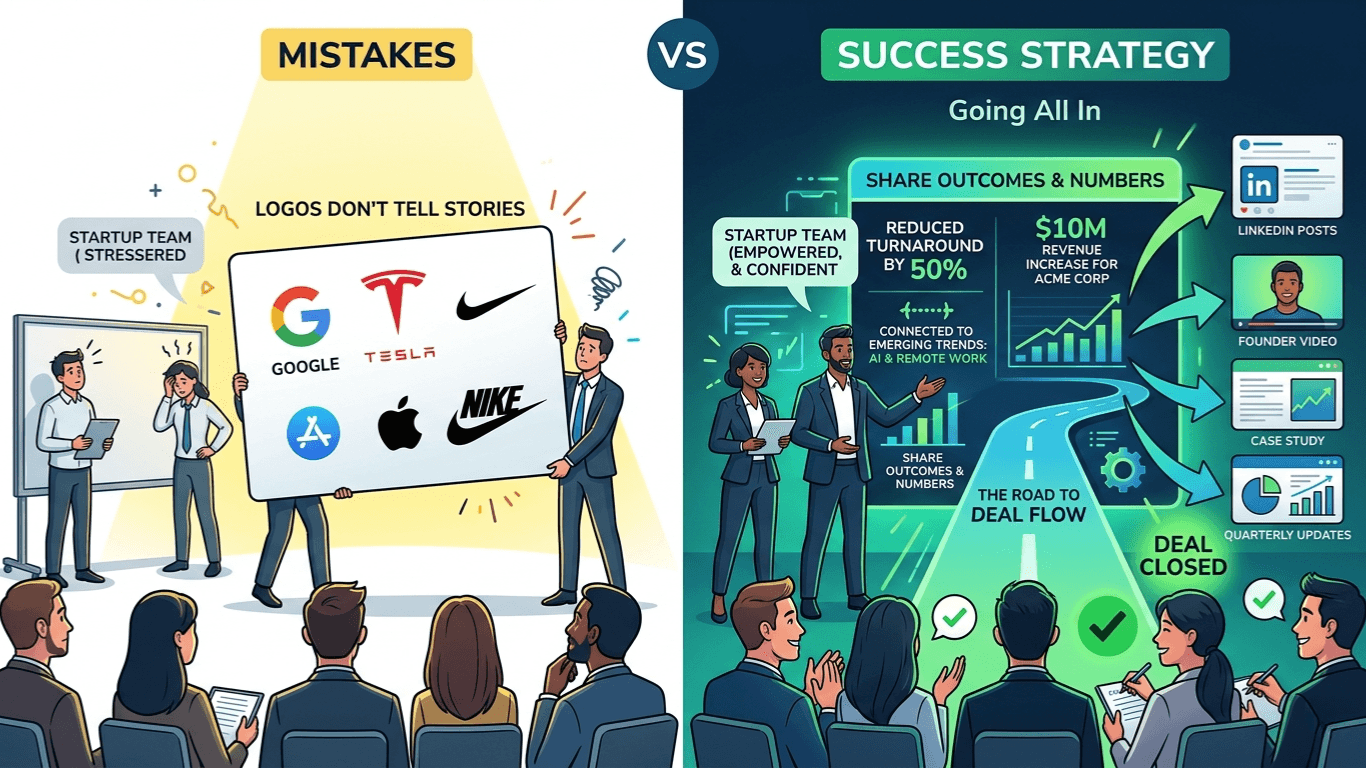
Mistake #1: Founders announce customers instead of outcomes
Recognizable logos hold a ton of weight for startups in growth mode. They offer instant credibility. They have a “head nod” effect on potential customers and investors. But logos don’t tell the whole story.
Despite being a best practice, popping logos onto a pitch deck or website will generate additional questions. Business evaluators and potential clients will want to know more. They’ll want to poke holes in that credibility and try to understand what exactly your startup did for that brand and how it’s going.
Are you prepared to answer those questions? You should be.
Rather than limiting yourself to a grid of logos on the pitch deck, startups can take a giant leap forward by including some performance data around their customer success. Think of this as answering the questions before they’re asked.
When customer data is proprietary, startups can opt to include broader data to the tune of: “On average, our agents reduced turnaround times by 50 percent for our global clientele.”
Mistake #2: They share the win once
If the customer success story is on the website or mentioned in the press release, the job is not done. That story is a high-value lead magnet that deserves a longer shelf life.
Customer success metrics can be sprinkled into the social calendar, logo or no logo, company names or not. They are an integral part of the sales and marketing strategy, and they should be included in all the places. They are also highly recyclable.
One customer story can become a LinkedIn post, a founder video, a customer quote, a case study, a newsletter feature, a conference example, or a media pitch.
The tactical shift here is to begin tracking your customer’s KPIs alongside your product and reporting on the benefits they’re seeing over time. This can be done for customers individually or collectively, or both. More data is never a bad thing.
Mistake #3: They fail to connect the story to a larger trend
Investors are particularly interested in how your startup fits into the greater picture. They want to understand why your product or service is playing a key role in the future of the workforce. They want to be able to quickly associate your traction and success with an emerging trend.
In her personal commentary around their $30M Series A, Hanah-Marie Darley of Georgie AI did this well. “Enterprises are no longer asking whether agents will matter,” she said. “They’re asking how to govern them as they move into production. For our customers, this becomes practical very quickly: security teams need a way to support agent adoption without losing visibility, control, or confidence.”
This could only be made more powerful if she had included some proof in numbers.
Mistake #4: They let the story go stale
A customer success story from 18 months ago with no updates is a liability, not an asset. Markets shift. Metrics improve. Relationships deepen. Startups that never refresh their success stories signal to investors and buyers that nothing new is happening.
The fix is simple. Build a rhythm of checking in with your key customers every quarter. Ask what has changed. Ask what has improved. Even a single updated data point can breathe new life into a story and give you fresh material to share across every channel.
Your customer success stories could be the proof an investor needs to turn a no into a yes, the tipping point for a high-value partnership, or the convincing moment that generates a multimillion-dollar deal.
Share your customer outcomes, often. Use numbers to illustrate proof. Tap into emerging trends to build trust. Keep your stories current. Don’t hold and fold. Go all in.